Sunday, October 1, 2023

Double Feature: Film Foliage or The 2 Best Films to Watch For Fall

"Don't you love New York in the fall? It makes me wanna buy school supplies. I would send you a bouquet of newly sharpened pencils if I knew your name and address." -Joe Fox, You've Got Mail

I'm not talking about Halloween movies. Im not a fan of scary movies as a whole. These are the two movies I like to watch when the air starts getting crisp and the leaves begin changing.
You've Got Mail, the 90s romcom, starring Tom Hanks and Meg Ryan. The Trouble with Harry, Introducing Shirley MacLaine in Hitchcock's 41st film.
I wish there were more to my list so that this article could be more "clicky." Maybe I'll find more and add them later for now these are the 2 movies to watch during the fall.
In our house, You've Got Mail has been the traditional film for the first day of fall. I'm not sure when that became the case but my wife and I enjoy sitting together and watching the film so much, why not give it a day. The film starts during the autumn in New York, meandering through the holidays and finishing in late spring. Truly, it could be watched at anytime of the year. It is one of the great 90s romcoms. As a history nerd I'm fascinated by it because it is a time capsule of before the change of the Millennium. New York before 9-11, the internet was still in its infancy, the big box store debates. Watch the film and see how the world has changed in the last 25 years. I grew up in the 90s and remember being dragged to the theater by my mom and older sister to watch this film. Now that I'm older it offers a great deal of nostalgia for me. Like a great big bowl of chicken soup for the soul. It's a 90s thing.

 The second film to watch in the autumn  is Alfred Hitchcock's The Trouble With Harry (1955). What is amazing about this film is that Hitch was also releasing To Catch A Thief the same year, further more Hitch had released 2 films the previous year and would go on to release 2 films the next year. I love the aesthetic of the film. One minute you're looking at orange foliage the next it looks like a play. That is exactly what you are seeing because, Hurricane Carol, heavy storms and colder than usual weather wrecked the New England Foliage. The country side was recreated on a Soundstage, according to historian Patrick McGilligan, Hitchcock sent leaf samples to the special effects team to get the color right (506).  I'm not sure why I love this film; it wasn't a film I watched a lot as a kid. Everytime I see the leaves start to change I feel like watching the Trouble with Harry.
These films aren't historical epics but they are time capsules. So whether Fall makes you buy all things pumpkin spice or as in the cinematic words of Joe Fox, "It makes me wanna buy school supplies. I would send you a bouquet of newly sharpened pencils if I knew your name and address." As the season get colder here are two recommendations for you. Let me know if you have recommendations of your own in the comment below.

sources:

McGilligan, Patrick. Alfred Hitchcock: A Life in Darkness and Light. New York: HarperCollins, 2003.


https://www.usatoday.com/story/life/entertainthis/2018/12/18/youve-got-mail-turns-20-all-best-quotes-rom/2335013002/

Sunday, September 3, 2023

History in The Future


Earlier in the summer I answered a question posed on a Facebook group called History Majors[i] about history and AI in the future. I was quite proud of my answer, this is a revised and extended version of that answer. I posted a link to the FB group page if you would like to see the original post.  


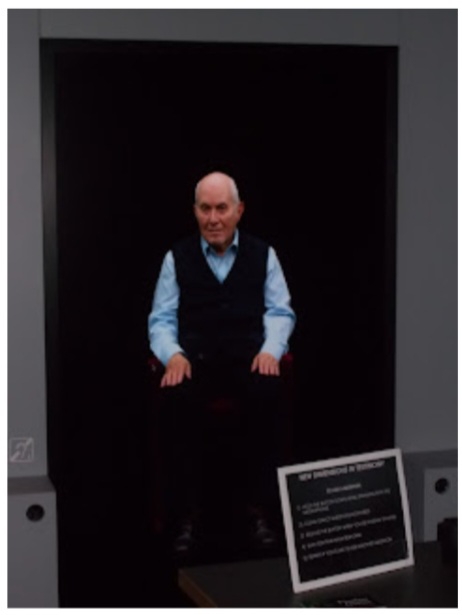
A few years ago I visited the Holocaust Museum in DC.[ii] One of the exhibits was a beta program where they had interviewed survivors for hours and hours and uploaded into a computer interface. This was Dimensions In Testimony[iii] a program sponsored by USC: SHOAH Foundation. There was a holographic image of the person and when you asked questions to the image, the computer matched your question to a story that the interviewee told during their interview. 


I would imagine that future iterations of AI will be able to extrapolate a life like image of historical figures using busts, portraits, and photographs to render a life like image. This may even be done today with more modern figures like Harry S. Truman or John F. Kennedy who were photographed and filmed for extended periods of time. This image would be able to move and talk to guests as hologram figures. AI would be able to gather primary sources such as letters and diaries and then be able to answer questions as that historical figure might. Thus far AI technology has not been able to speak, that may change in time.

The example that I see in my mind is George Washington walking into the Mount Vernon welcome center and greet guests to his home. 


AI has gotten a lot of press lately (mostly negative) since Hollywood has screeched to a halt with the Writers Guild and SAG-AFTRA strikes. There are some legalities to work through and technological advances to work out. AI would be an interesting addition for museums and historical sites to use in their tours.  My hope is that museums seriously look at new technologies to present historical research to the public.


Sunday, August 27, 2023

A Limited Book Review: Killing the Rising Sun

 This book is fast paced, engrossing, some parts are highly entertaining. The chapters are short and well paced making for a fast read. I would call it a history appetizer to whet your appetite for learning about the pacific war in WW2. Sgt Bastione, PFC Doss, General MacArthur,  J. Robert Oppenheimer and the development of the A Bomb and much more are all mentioned. 

That being said I did have several issues with this book. I wasnt going to gripe about facts since im not very knowledgeable about WW2 history. However, I do have one gripe about the facts in the book. On page 242 the author says "A thousand Soviet Tiger tanks and Sherman tanks "on loan" from the Americans face absolutely no armor on the Japanese side." To my knowledge the Soviets didn't have a tank called Tiger and did not operate captured German Tigers in large numbers. I don't know if this is a typo, a misquote or simply an awkward sentence.  This is a minor point but I do have four, what I call, "Red Flags" popped out at me.

1. I don't trust Nonfiction books that actually say this is the "true story." As a nonfiction it should be implied that what the author is saying is at least the authors interpretation of true facts and events. The fact that the author has to explicitly say this is true makes me suspicious. "What Martin Dugard and I are about to tell you is true and stark." pg2. 

2. The second red flag is when I constantly say to myself how does he know that? Not that I doubt the history presented but when the author says "Sachs chooses his reply carefully (pg 3)." Or "The morning heat is so unbearable that Corporal Lewis Kenneth Bausell, USMC, has trouble breathing (pg7)." How do we know that was what he was thinking or feeling? Was there a photograph, a film was this person interviewed? If so let me know how we know, otherwise I'm concerned that the author is so focused on building the drama of the scene that they drift from historical fact. If you don't know say so or leave it out.

3.This book doesn't have a bibliography. A bibliography is not necessary as long as you site the sources used in your book. Killing the Rising Sun does have a source page. My gripe may just be a personal preference. I believe Histories should have bibliographies or at least extensive chapter notes to give the reader a chance to evaluate where is the author getting his information and how old is his information. 

4. My final issue is the way history is used. I don't doubt the facts of atrocities committed by the Japanese army at Nanking or that PFC Desmond Doss, Medal of Honor recipient, was a hero, but when these two stories are juxtaposed with each other to illustrate evil of one versus the virtue of the other, I have to question the motives. 

Like I said I dont doubt the facts but the usage of the narrative makes me doubt the truthfulness of the narrative. 

I did enjoy reading this book, it reminded me of my favorite questions about history. "What is history? and Why do people study it?" However if someone asked me for a book recommendation about the Pacific war, it would not be this one. 


Tuesday, August 11, 2020

A Limited Book Review Part II: A Concise History of Japan


Walker, Brett L. A Concise History of Japan. Cambridge, UK: Cambridge University Press, 2015.

This is the second book review that I have posted on this blog, so it is only appropriate I call it “A Limited Book Review Part II,” for obvious reasons. If you are interested in my first Weaving Chronicle Book Review here is the link https://theweavingchronicle.blogspot.com/2017/01/a-limited-book-review-last-founding.html. Shameless self-promotion finished, here is my limited book review.

A Concise History of Japan is a fairly easy read, Brett Walker moves the narrative along at a good clip. If you are looking for an easy history to pad your book count. The pagination is only 304 pages and 15 chapters so it is a really easy read (chapter lengths average only about 20 pages per chapter).

The following quote sums up the philosophy of the book. Focusing on the big picture of history or as the French say Longue Duree (literally Long duration). This term Longue Duree is also a historical term coined in the 1960s to describe the long view of history, attempting to see all the complexities of history. The perspective has gained favor again in the 21st century especially in the context of environmental history.

"...context of the historical longue duree, one lesson of environmental history is that the physical stage on which our past unfolds is unstable and dynamic, just like the human societies it supports and sustains. But climate change threatens to amplify that transformative process several fold.

That being said, this book is not an environmental history per say. Rather, this book is what I imagine history should look like in the twenty-first century, as ice sheets and glaciers melt and sea levels and storm intensities rise." - Brett L. Walker, A Concise History of Japan (xvii)

It's “not an environmental history”, but you can tell that is what he wanted to write. My biggest complaint of the book is with its organization of the book. The author will be going through the Empire and Imperial Democracy, 1905-1931 (Chapter 12) and then BAM! He gives three whole paragraphs on the "legacy" of over fishing and whale hunting into the 21st century (227-229). Call me old fashioned but if the chapter title says “1905-1931” than you should focus on “1905-1931.” This bit would have been better suited later in the book or maybe a complete reorganization to incorporate more environmental history themes.  As the book reads now, it is as if the author copied and pasted some last minute additions into the original manuscript. There are other instances where the organization goes askew but this was by far the most noticeable.

There are some redundancies and I wish the author had given more definitions, even if it was only in the glossary. I suppose defining everything would have made it less concise and more introductory. These are my only gripes about the book, I found it interesting and helpful. I was looking for a quick history to bolster my understanding of Japanese history and this was a good choice.

Wednesday, July 15, 2020

Adventures in Herodotus


My goal was to read a list of classic and famous historians in chronological order. I called this list my practice grad-school (I’ll have to write a blog post about). What better historian to start with, than the Father of History himself, Herodotus!  I love history and have really enjoyed reading Herodotus’ The Histories but I didn’t know what I was getting myself into.  I did not have any background in Greek history, and Herodotus can be a little disorienting, so here is a post of what I did to help get through one of the greatest works in history.

First off, Herodotus doesn't write like we write today so get ready! Herodotus will frequently interrupt himself with background narrative or geographical/ethnographical info, all of it is super interesting but a bit jarring. Classicists call these interruptions “digressions.” In Book IV, Herodotus describes Dareios’ campaign against the Scythians from paragraph 1-4 then Herodotus interrupts himself and from paragraphs 5-82 he talks of Scythian culture. Then in paragraph 83 he starts talking of Dareios preparing his campaign again. There are more jarring examples but this is the longest if you don’t count book II.

He also gives a lot of names, people, people's fathers, places, places fathers. Here is what I mean...
“Moreover of the Persians there fell here, besides many others of note, especially two sons of Dareios, Abrocomes and Hyperanthes, born to Dareios of Phratagune the daughter in marriage to Dareios gave also with her all his substance, because she was his only child. 7.224b”
Now if you can read that sentence once and get what the heck he is talking about, you’re a whole lot smarter than I. Granted it was written 2400 years ago and then translated into English. Perhaps I shouldn’t criticize too harshly.

Chronology can also be hard to keep track of if you are not familiar with ancient Greece. Herodotus seems unworried about providing regular dates, of course he didn't know that Christ would be born some 400 years in the future so BC wouldn’t have made any sense to him.  Nor did he realize that he wasn’t living in the “common era,” so “Before the Common Era (BCE)” wouldn’t have occurred to him.  His timelines are all over the place and kind of vague, most coffee table tomes would help keep the chronology strait.  I used "Empires that Shook the World" by Andrew Taylor, it is a typical coffee table book. It has sections on the Athenian Empire (or Delian league) and the Achaimenid Empire (or the Persian Empire), it isn’t a spectacular work but it does have plenty of pictures, timelines, graphs and maps to help guide you through ancient Greece.

I also took advantage of two audio resources, the Open Yale Courses (https://oyc.yale.edu/) they can be found wherever you get your podcasts as well as from the website provided. I listened to Professor Donald Kagan’s Ancient Greece class. I highly recommend it for general knowledge of Greek history. Here is a full bio provided by Yale (https://history.yale.edu/people/donald-kagan).  I also took advantage of my public libraries resources which included The Great Courses’ presentation on “Herodotus.” It is taught by Professor Elizabeth Vandiver. Here is a full bio provided by The Great Courses (https://www.thegreatcourses.com/professors/elizabeth-vandiver/). This has been a great resource for more specific context for The Histories itself.


I hope you enjoy your journey through The Histories.  And when you know your Perses from your Persians, you can go to your friend’s party and when they start praising that 300 movie! You can pull out book VII and say “well Herodotus actually said…,” that may be only my fantasy.
P.S.
If you are interested, my next book on my list is Thucydides! Go figure.

Herodotus. Herodotus: The Histories. New York: Barnes & Nobles Books, 2004.
Taylor, Andrew. Empires That Shook the World. New York: Metro Books, 2008.


Saturday, May 16, 2020

Chronicling COVID


Just as the World Wars and the Great Depression defined the 20th century as we know it; The COVID-19 pandemic is one of the defining events of the 21st century. Stay at home orders are lightening up and questions about what the pandemic means for policy and personal decisions are coming to the forefront. It is important to chronicle and remember some of the images of the pandemic.
Caution tape to close the playground
The pandemic is not over by any means and here is some pictures that reminded me of that fact today as I took a walk in my neighborhood.


Monday, February 25, 2019

Dr. Strange Love: or How You Should Stop Worrying and Love History


I have been thinking a lot about this academically trained historian versus independently trained historian business  for some time. For the sake of full disclosure and so one may see where I'm coming from, I went to Liberty University graduated Cum Laude with a Bachelor's in history. I worked three years giving tours at two museum/historical sites but wasn't to find a full time position. I started work on a Masters degree at James Madison University but quit after a semester due to health as well as just being burned out on school.

Since not being connected to any academic institution for about four months; I have tried to stay up to date on the history world. And recently read two articles both flying warning flags about the future of the study of history. 

The first article an opinion piece from Max Boot for the Washington post about the sorry condition of American's knowledge of American history. He points out the decline of history majors in Universities around the country. Including the fact that the University of Wisconsin at Stevens Pointe had considered discontinuing history classes all together (at the time of this writing I don't know if they actually called it quits on their history program). The second article, A New York Times piece talked about President Obama's Presidential Center and how it won't technically be a Presidential Library. It won't actually house a physical collection. Obama's papers will be digitalized and accessed online. Some Public Historians have voiced concerns about what this means for scholarship on the Obama Administration in the future.  A digital collection can be easier to limit scholars access; as well as concerns about curation and preservation. If there isn't a repository for donations, items not already in the National Archives collection may be lost. 

The theme in both of these articles is how we study the past is changing. No longer is historical knowledge just being distrubuted through universities and museums. Some call this trend the democratization of history. 

President Obama's documents being put online instead of a physical collection or the apparent lack of interest in making history ones prime vocation in the coming generation. These are not signs of the end, on the contrary these are merely signs that history is being less centralized.  History as an interest is actuality booming. Genealogy sites are everywhere and thriving from subscription sites to genetic testing. Documentaries are available where ever films are sold or streamed. Podcasts and blogs from amateur historians are easily found on the internet. Historical knowledge is readily available to all who is looking. What is collapsing is the professional apparatus, the academy. 

After 2008 many saw the falling number of social science majors as a sign of the recession. Ten years after the fact, and we are still seeing these numbers fall.  The academy is in the awkward position training young people one discipline (a very expensive training), many millennial have gotten used to the idea of the side hustle, working two and three jobs at once.  

Even those we consider professional historians have not come directly from the academy. Nick Bunker, author of An Empire on the Edge, in an interview stated that he had careers in journalism and finance before writing two critically acclaimed history books. 

Don't freak out! The study of history as an academic discipline is relatively new. The first PhD awarded in the US, ever, was from Yale in 1861. The academic system that we know today has only been around for about 200 years. People have been studying history without history degrees for centuries. Think of Herodotus, Thucydides, or Polybius. According to one story Edward Gibbon thought his brief stay at Oxford was a waste of time. Just because there are fewer history majors doesn't mean the world will collapse into idiocracy or an Orwellian nightmare. Or that history will be forgotten (any more than it already has). There will still be those who have questions, those who will want to know how did we get here and those who love the stories.

So, stop worrying and learn to love history.